Companies that need houses in Los Angeles for July 2028 will not get them through the official hospitality program unless they buy its top tier. They will get them the way corporate travel has always worked in this city: a furnished residence on a lease of thirty-one nights or more, signed early, with extension rights written in. This guide explains what the official channel covers, what the capacity numbers say, why the 31-night lease is the instrument, and when to sign.
For shorter working stays outside the Games window, see our guide to workation villas in Los Angeles with fast wi-fi.
What the official program covers, and what it leaves to you
On Location is the official hospitality provider for the LA28 Games and the only authorized seller of ticket-inclusive hospitality packages. Its corporate and group menu runs from In-Venue packages (official tickets, lounge access, food and beverage) to Private Suite packages, and up to a bespoke tier called Platinum Access that bundles premium seats, hospitality, luxury hotel stays, transportation and a program-management team. Hotels are not part of the standard corporate packages; they can be added through the sales team from a curated hotel collection, before or after purchase. Airport transfers are reserved for the bespoke products, and transportation for the other tiers is, in the program’s own words, still being evaluated. The inquiry form asks for a budget band that tops out at “100k+”.
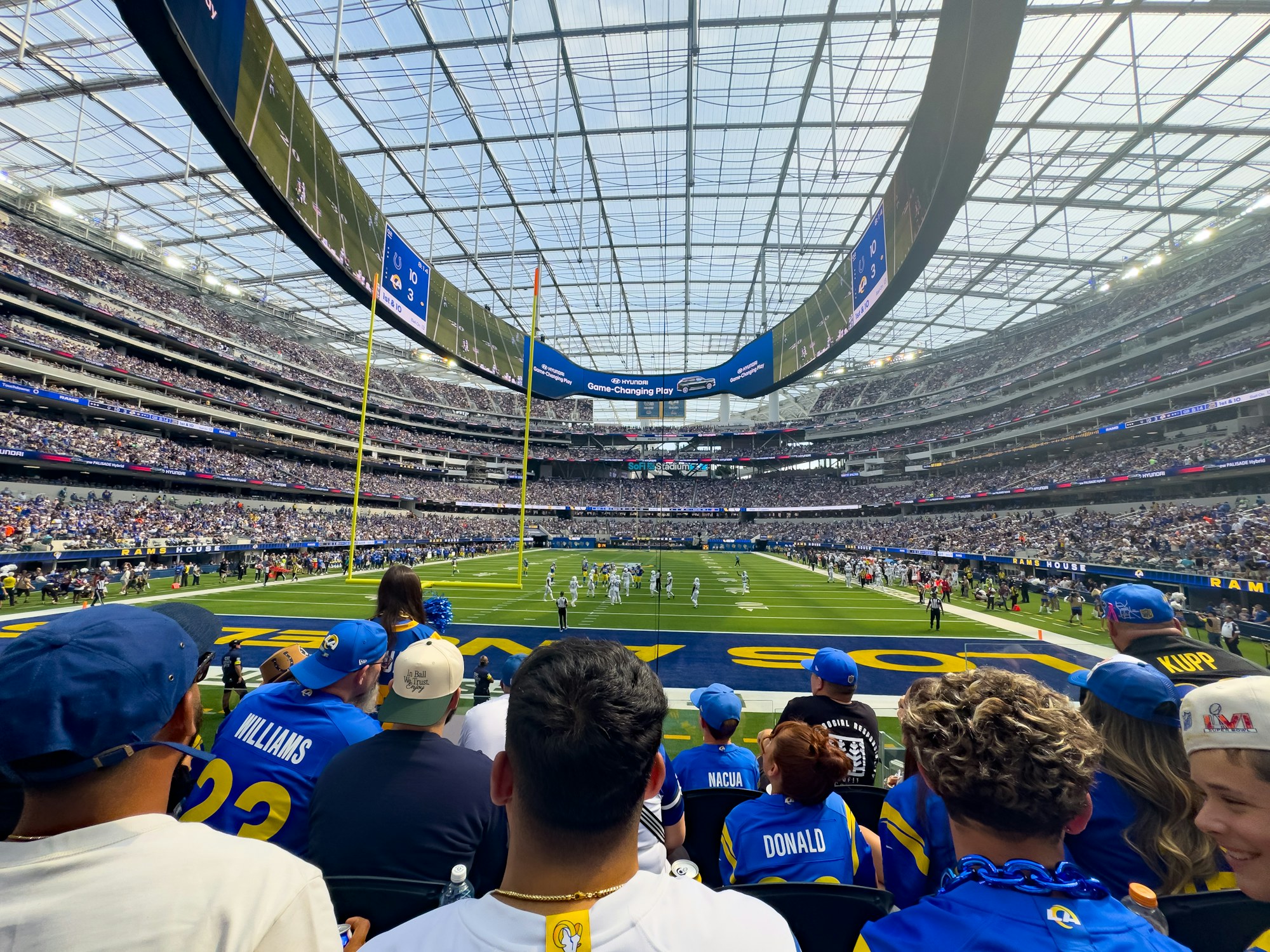
That is a ticketing and hospitality program with hotels attached, not a housing program. LA28’s own visitor FAQ says as much: it points guests to Airbnb, a Worldwide Olympic Partner, to the hospitality packages, and to a single piece of advice about location, which is to stay near the zone where you plan to attend the most events. For a company bringing forty people to Los Angeles for three weeks, the question of where those forty people sleep is left to the company.
The sponsors who will be doing this are now a long list. LA28 has passed two billion dollars toward a 2.5 billion dollar domestic sponsorship and licensing target, with Comcast, Delta, Honda, Starbucks and Intuit as founding partners, Google and Cisco in the tiers below, and Uber, Oakley and Fanatics among the suppliers. Each of those programs comes with hospitality obligations to clients and employees, and each will need a residential footprint that a hotel block cannot provide: a kitchen for a chef, a dining room that seats sixteen, a pool and a view that make the guest feel the city rather than a lobby.
The arithmetic of July 2028
The most detailed public capacity model is a Deloitte Finance study prepared at the request of Airbnb and published in February 2026, with data current to November 2025. Read it knowing who paid for it, but read it, because nobody else has published the arithmetic. It takes LA28’s estimate of fifteen million total visitors, assumes roughly three-quarters attend the Olympics, that about 28 percent of those attendees are tourists who need lodging, and that about 69 percent of those tourists pay for it. That yields about 2.1 million paying visitors staying an average of 3.5 nights, or 7.4 million room nights, with demand peaking on July 22.

Against that it counts about 157,800 hotel rooms across Los Angeles and Orange counties by 2028, which at a 92 percent occupancy assumption houses roughly 276,000 people a night, plus about 30,000 short-term rental nights a day housing a further 100,000 or so. The conclusion is that demand exceeds capacity on 13 of the 19 competition days, and that about 1.1 million nights, roughly 15 percent of demand, would be redirected outside the two counties unless supply grows. The study’s own benchmarks for pricing are instructive: Super Bowl LVI in 2022 pushed the Los Angeles hotel average daily rate to about 384 dollars, more than double the same week in 2019.
Two caveats matter for a corporate planner. First, the model counts tourists; it explicitly excludes the pre-contracted, long-stay inventory for accredited stakeholders such as workforce, media, officials and delegations, which is exactly the category a sponsor program resembles. Second, Los Angeles is not Paris. The venues run from the San Fernando Valley to Long Beach and Carson, the Athlete Village sits at UCLA in Westwood, the media village is at USC, the broadcast center is at the Warner Bros. Ranch in Burbank and the press center at the NFL’s Hollywood Park headquarters in Inglewood. Demand will not pool in one arrondissement; it will pool on the Westside, because that is where the Village, the sponsor offices and the houses are.
Why the 31-night lease is the instrument
The City of Los Angeles Home-Sharing Ordinance governs stays of thirty consecutive days or fewer. Under it, only a host’s primary residence may be rented short-term, with a 120-night annual cap unless the host holds extended registration, and second homes and investment properties are excluded. A stay of thirty-one nights or more is simply a tenancy, outside the ordinance and outside the city’s 14 percent transient occupancy tax, which applies to occupancy of thirty days or less. That is why corporate housing in Los Angeles has always been structured at thirty-one nights and up, and why the Games will be no different. Our corporate housing in Los Angeles page sets out the standard terms.
Planning a luxury California stay?
Skip the guesswork. Villoura specialists match you to the right villa and handle every detail, a real person replies in minutes.
The city’s proposed exception, Council File 25-0029-S1, would temporarily let owners rent second homes to visitors through the end of December 2028. As of this writing it has not been adopted. The Planning and Land Use Management committee took public comment in May 2026, its chair has said he will not hold a hearing until city departments deliver long-requested enforcement reports, and Capital & Main reported on October 26 that Airbnb had put 7.1 million dollars into this year’s mayoral and council races, with the ordinance’s fate widely seen as resting on the November 3 election results. A company cannot plan a 2028 program around an ordinance that may never pass. It can plan around a lease.
The neighboring cities are stricter still. Beverly Hills adopted a one-year minimum on all residential rentals in 2025, which is now the subject of litigation; West Hollywood prohibits unhosted stays under thirty-one nights; Santa Monica allows hosted home-sharing only. In all of them, a lease of thirty-one nights or more in Los Angeles, or of a year in Beverly Hills, is the lawful form. One more term to know: a tenancy in the City of Los Angeles that runs past six months brings the Just Cause for Eviction Ordinance into play, so a Games block is best written as a fixed term under six months with a priced option to extend, rather than an open-ended lease.
The Westside map for a corporate block
Where a company blocks houses depends on who is sleeping in them and where they need to be at eight in the morning. For a program centered on the Village and on UCLA’s hospitality, Bel Air, Holmby Hills and Westwood are the obvious ring; our guide to the Olympic Village at UCLA and the neighborhoods around it maps the streets. Brentwood and Santa Monica put guests on the coastal end of the Games Route Network with a quieter evening; Santa Monica is not a competition venue, which is part of its appeal for a guest program that wants the beach without the crowds.

Century City and the Beverly Hills border are where sponsor offices, law firms and agencies already sit, and where the Metro D Line’s Century City and Westwood stations are forecast to open in 2027. Culver City, Playa Vista and El Segundo serve a technology or aerospace headcount. The Hollywood Hills and Studio City serve a broadcast team working out of Burbank. Hidden Hills and Calabasas work for a group that wants acreage, gates and a single compound rather than a street of houses. Our LA28 venue map by neighborhood and our guide to getting around Los Angeles during the Games cover the zones and the transit plan in detail; the short version is that a corporate block should be chosen for its morning commute, not its view of SoFi Stadium.
What Paris taught corporate travel managers
Paris 2024 is the closest precedent, and its lesson is two-sided. Corporate housing platforms reported that their Paris partners prioritised existing clients and stays of at least three months, and recommended block-booking anything over a month well before the twelve-month mark. The blocks that got signed early got signed; the companies that waited found availability released in phases at the top of the rate card. That is the supply side.
The demand side was humbling for speculators. In April 2024, three months before the Opening Ceremony, Fortune reported that luxury agencies in Paris had cut asking rents by half, that owners who had listed at three or four times their normal nightly rate were finding no takers, and that AirDNA counted about two-thirds of available nights in four- and five-bedroom Paris apartments during the Games still unbooked. Affluent visitors, it turned out, had booked a year earlier, when their tickets arrived. The conclusion for a corporate planner is not that Games housing is cheap; it is that the serious money transacts early and at a disciplined premium, and that the inventory still on the market in the final quarter is the inventory nobody wanted. Villoura’s view, set out in our guide to Olympic villa rentals and what they cost, is that a well-located Westside house on a 31-night lease should command a meaningful premium over its ordinary summer rate, not a fantasy multiple.
A timeline from now to the Opening Ceremony
LA28 says more than six million tickets have already been sold, that further sales run first come, first served, and that an official resale platform opens in 2027. On Location has sold hospitality since April 2026. The practical calendar for a company therefore runs as follows. Before the end of 2026, define the program: headcount, arrival and departure waves, the venues that matter, and whether guests are executives, clients, athletes’ families or a broadcast crew. In the first half of 2027, sign the residential block, because that is when the Westside houses that are willing to take a 31-night Games lease will be committed, and because the Metro D Line extension and the LAX automated people mover, now targeted for early 2027, will both be visible by then and will change which streets feel convenient. Through late 2027, layer on the hospitality packages, drivers, chefs and security, and confirm extension rights for the Paralympic Games, which run August 15 to 27. The first half of 2028 is for substitutions and contingency, not for first signatures.
Terms a company should insist on
A Games block is a commercial contract, and it should read like one. The lease should name the occupants and permit substitution, because the vice-president who was coming in July may be replaced by the client who matters more. It should fix a term under six months with a priced extension, cover housekeeping and linen at a corporate cadence rather than a holiday one, specify the chef’s kitchen access and the staff entrance, and set a cancellation ladder that releases part of the deposit if the program is cut back before a stated date. It should state who holds the keys to the gate, the alarm and the pool house, and it should confirm that the home is not registered under the Home-Sharing Ordinance, because a 31-night corporate lease has nothing to do with that regime and should not be papered as if it did. Villoura’s corporate agreements already carry these clauses; our guide to where executives stay in Los Angeles for 30-, 60- and 90-day assignments explains how they work outside the Games.
For owners: what a corporate block pays, and why it is the better Olympic bet
A Westside owner weighing the Games has two paths. One is the speculative nightly listing, which in the City of Los Angeles is lawful only for a primary residence under the 120-night cap and which, if Paris is a guide, risks sitting unsold at an inflated ask. The other is a single corporate lease of thirty-one nights or more: one counterparty, one check, a named company behind the damage deposit, no transient occupancy tax, no home-sharing registration, and the house back in time for September. Villoura leads with the second. Our briefing on Los Angeles short-term rental rules for 2028 explains the regulatory background, our owner guide to the February 2027 window is the rehearsal, and owners who want their house considered for a sponsor or federation block can start at list your home with Villoura.
How Villoura structures a Games block
We house companies in Los Angeles on terms from thirty-one nights to a year, with executive stays from three nights for the short visits around them, and we treat the 2028 Games as the same assignment at scale: a shortlist of residences chosen by commute, a single master agreement with substitution and extension rights, housekeeping and concierge on a corporate cadence, and a specialist who answers within fifteen minutes. The LA28 page sets out the three booking modes we run, from ticket-block stays of three to ten nights to full-Games leases and estate blocks for federations and sponsors; Villoura Concierge covers drivers, chefs and access; and a corporate travel manager who wants to start a conversation about 2028 can speak with a villa specialist now, while the Westside houses are still unspoken for.
Frequently asked questions
Does the official LA28 hospitality program include housing?
Only at its bespoke Platinum Access tier, which bundles luxury hotel stays and transportation with premium tickets. Standard In-Venue and Private Suite packages are ticket-and-hospitality products; hotels can be added from a curated collection through On Location’s sales team. Private residences are not part of the program.
Can a company legally rent a house in Los Angeles for the Games?
Yes, on a lease of thirty-one nights or more, which is an ordinary tenancy outside the Home-Sharing Ordinance and outside the city’s transient occupancy tax. Stays of thirty days or fewer are restricted to a host’s primary residence. Beverly Hills requires a one-year minimum; West Hollywood prohibits unhosted stays under thirty-one nights.
When should a corporate block be signed?
Define the program before the end of 2026 and sign the residential block in the first half of 2027. The Paris precedent is that providers prioritised early, longer commitments and released remaining inventory later at the top of the rate card, while the affluent individual market had largely booked a year out.
How large is the expected accommodation shortfall?
A Deloitte study commissioned by Airbnb models about 7.4 million paid room nights of visitor demand against roughly 157,800 hotel rooms in Los Angeles and Orange counties, and finds demand exceeding capacity on 13 of 19 competition days, with about 1.1 million nights redirected elsewhere unless supply grows. Treat the figures as a commissioned model rather than a forecast.
Which Westside neighborhoods suit a sponsor program?
Bel Air, Holmby Hills and Westwood for proximity to the Athlete Village at UCLA; Brentwood and Santa Monica for the coast; Beverly Hills and Century City for offices and hospitality; Hidden Hills and Calabasas for a gated compound; the Hollywood Hills and Studio City for a Burbank broadcast team.
What premium should an owner expect from a corporate Games lease?
A meaningful premium over the ordinary summer rate for a well-located house on a 31-night term, paid by a single corporate counterparty. Owners who price at Paris-style multiples of three or four times normal risk the outcome Paris saw in 2024: unsold inventory and last-minute cuts.